
Key takeaway:
The capital has arrived. The intelligence to deploy it well has not.
- The land play is over. The return has moved to the mid-chain between paddock and port.
- Input security, fertiliser and fuel, is now a board-level risk, and the government has priced it as one.
- Capital is choosy. The operators who can prove they move product under stress are the ones it backs.
- Vaxa helps boards turn these signals into tested, executable plans.
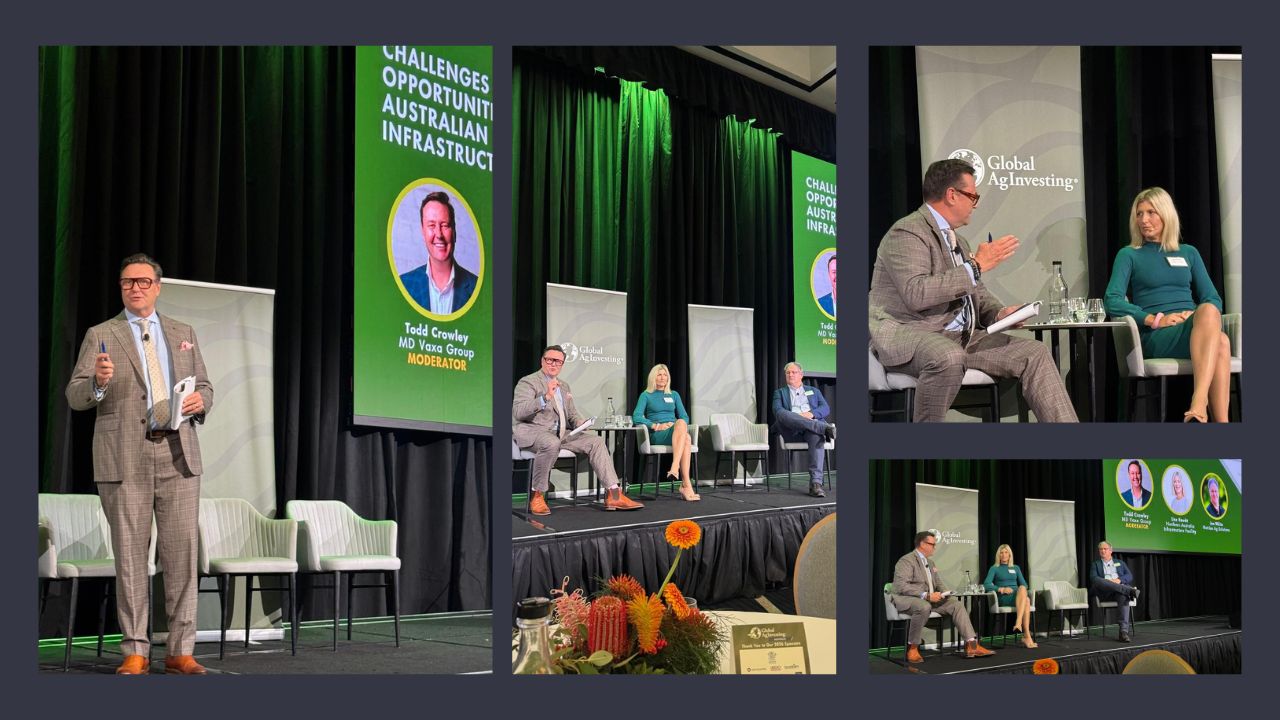
Vaxa Group’s Todd Crowley moderated the panel on Australian ag infrastructure at Global AgInvesting (GAI) Australia, held at Brisbane’s Sofitel on 10 to 11 June 2026. It was the first time the event, run annually for the past 17 years in New York, London and Tokyo, has been held in the southern hemisphere. He was joined on stage by Lisa Hewitt of the Northern Australia Infrastructure Facility and Queensland Rail, and Jon White of Nutrien Ag Solutions.
The room held around 350 institutional investors representing more than $10 trillion in assets under management. Australian agriculture arrived at the event on a record, with production value crossing roughly $100 billion for the first time, and the government’s own forecaster expecting it to soften next year. The theme underneath the two days was straightforward. The capital is ready. The question is whether the system it wants to back can survive contact with a real supply chain.
What the room leaned into
1) The land play is over. For two decades, Australian agriculture was a land story. You bought the dirt, the dirt appreciated, and the return looked after itself. With land values flattening, that era is closing, and every serious allocator in the room has worked it out. The return now sits in the middle of the chain, not the ground beneath it. That reframes what a good agrifood asset even looks like, and it rewards operators over passive holders.
Moves to consider
- Reassess held positions on operational cadence and margin capture, not land appreciation.
- Separate assets that produce from assets that can also move and process what they produce.
- Treat management that designs for disruption as a value driver, not a compliance line.
2) Input security is now a board-level risk. Australia produces only around 15 per cent of the fertiliser it consumes. Urea, the most-used product at roughly 44 per cent of consumption, ships overwhelmingly from the Persian Gulf through the Strait of Hormuz, currently disrupted. On fuel, the country has sat below the International Energy Agency’s 90-day stockholding obligation since 2012, with diesel cover estimated at only three to four weeks. This is no longer a theoretical exposure. In its 2026-27 Budget the Commonwealth created a single $7.5 billion Fuel and Fertiliser Security Facility, bundling a farm input and the fuel that moves an economy into one security instrument. When the Treasury reclassifies your supply chain as national infrastructure, the question is whether your own risk model has caught up. For the full brief, see Australian Agrifood Has Capital but No Map and our earlier work on Australia’s Phosphate Risk.
Moves to consider
- Baseline exposure to imported fertiliser and fuel across each enterprise or fund.
- Stress-test one core operation against a sustained input disruption. Most models do not have this switch.
- Build optionality: offtakes, pre-buys, contingency logistics, and where viable, participation in domestic supply.
3) The midstream is the real opportunity. We talk about Australian agriculture as though it stops at the farm gate. It does not. The crop still has to move, get processed and reach a port, and that stretch between paddock and port is where the industry quietly loses margin every year. The handling, the storage, the technology and the logistics went underfunded for a generation while land did the lifting. The panel drew out how uneven the picture is, from a northern industry served by barely a handful of abattoirs above Rockhampton to a southern system running short on water and processing closer to market. Different problems, same conclusion. The mid-chain is underbuilt, and it is where the next decade of return sits.
Moves to consider
- Map where margin leaks between production and port across your assets or portfolio.
- Prioritise processing, storage and freight capability as investable infrastructure, not overhead.
- Read the north and south as two distinct infrastructure markets, not one national average.
Our take on the AGIS signal
- Capital is available, and it is choosy. It backs operators who control their inputs and can prove they keep product moving when conditions tighten, not narratives.
- The gap is intelligence, not appetite. In a category this technical, understanding the whole system is the advantage. The allocator who reads the exposure before the market reprices is the one who captures the return the cautious money leaves behind.
- The middle is the opportunity. The unglamorous mid-chain, processing, storage, freight and the technology around them, is where Australia has underbuilt and where the return now lives.
- Producers are carrying too much of the risk. They are asked to feed the country, hold the line on food security and absorb input shocks at once. Policy settings should lower the barriers to building domestic capability, not raise them. The capital is here. The appetite is real. What is missing is the will to build the middle that makes the whole thing work.
Where Vaxa Group helps
We work with boards and executive teams to turn these signals into plans that hold up under scrutiny.
- Critical input security: exposure mapping, hedging strategy, domestic-supply pathways and procurement playbooks anchored to real options.
- Supply chain and midstream: modelling where margin is lost between paddock and port, and building the logistics and processing picture that makes an asset investable.
- Infrastructure intelligence: a read of the whole system, inputs to demand, mapped against your specific position, so you deploy with a map rather than a thematic tailwind. This is the work of Vaxa Bureau.
Don’t wait for the next price spike or policy change to force your hand. If this sits on your risk register, let’s get clarity, together.
Read the full intelligence brief behind this article, Australian Agrifood Has Capital but No Map, and secure Early Access to Vaxa Bureau at vaxabureau.com.

