Key takeaway:
Build resilience now—secure inputs, price nature risk, and make trade claims provable.
Map and hedge phosphate exposure; create domestic supply options.
Put natural capital metrics into finance and link them to cost of capital.
Ensure ESG and traceability are verifiable to keep market access.
Vaxa helps boards turn these into executable plans.
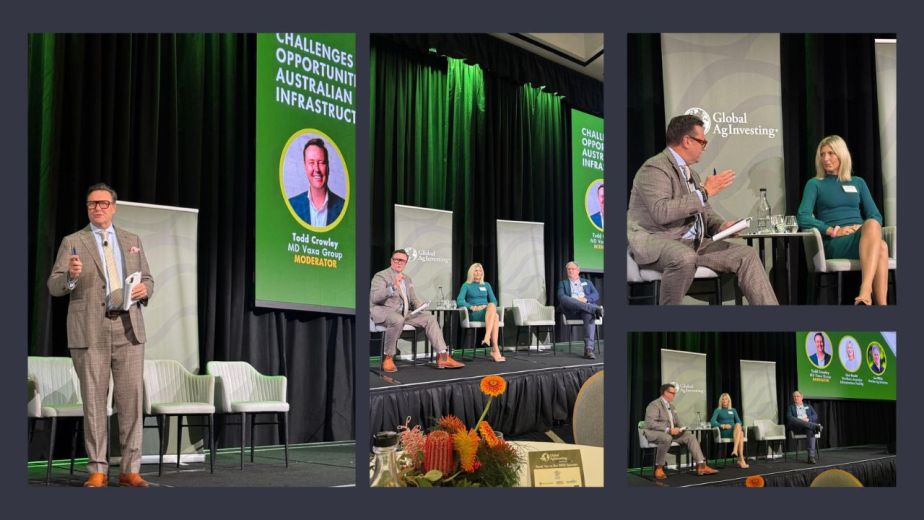
Our team joined investors, producers and policy leaders at the 2025 Australian AGinvestment & Sustainability (AGIS) Summit at Brisbane’s Royal International Convention Centre on Friday, 29 August 2025. The program put hard questions on the table: financing resilient production, treating nature as financial risk, and keeping trade routes open under pressure.
What leaders leaned into
1) Fertiliser security is now board-level.
Australia’s reliance on imported phosphate leaves producers exposed to geopolitics and freight shocks. Margins shrink first; yields follow. If you haven’t mapped exposure, you’re betting the season. For a deeper brief and podcast with John Cotter, start here: Australia’s Phosphate Risk.
Moves to consider
Baseline exposure to imported fertiliser across each enterprise or fund.
Stress-test price/availability against production plans and covenants.
Build optionality: offtakes, pre-buys, contingency logistics, and—where viable—participation in domestic supply.
2) Nature on the balance sheet, not in the footnotes.
Investors and lenders are pricing nature risk. Natural capital accounting lets CFOs quantify soil, water and biodiversity dependencies and carry them into cash flow, insurance and cost of capital. Our discussion with CSIRO’s Dr Tony O’Grady outlines the practical path for finance leaders.
Moves to consider
Map material dependencies and impacts across assets and supply chains.
Use TNFD-aligned metrics and put them into board packs and lender conversations.
Tie reporting to financing terms so discipline converts to lower spreads.
3) Trade is a capability, not a hope.
The Sustaining AGtrade session underlined how export access will hinge on credible ESG claims, proof of chain-of-custody, and agility when rules change mid-voyage. Teams that prepare now will ship while others renegotiate.

Our take on the AGIS signal
Capital is available, but it’s choosy. It chases operational cadence, measurable outcomes and management that treats risk as a design input, not a press release.
ESG has moved from talk to tooling. The app, live feedback and the venue’s standards show where reporting is heading: real-time, verifiable and connected to dollars.
Networks matter. Structured touchpoints—the morning Smoko and Sundowner—are smart design. Deals ride relationships; relationships need time and a plan.
Where Vaxa Group helps
We work with boards and executive teams to translate these signals into plans that hold up under scrutiny:
Critical input security: exposure mapping, hedging strategies, domestic-supply pathways, and procurement playbooks anchored to real options. (See Phosphate Risk.)
Nature-linked finance: TNFD-ready metrics, decision dashboards for CFOs, and investor-grade disclosures that earn flexibility when markets tighten. (Start with Natural Capital Accounting.)
Trade-readiness: ESG claims that can be proven, product traceability, and scenario planning for fast policy shifts.
Don’t wait for the next price spike or policy change to force your hand. If this sits on your risk register, let’s get clarity—together.